Light in the tropics does not diffuse gently across the landscape. It strikes with force, carving the world into sharp contrasts—radiance beside shadow, warmth beside unease. In the paintings of Bernadette Despujols, this condition becomes more than atmosphere; it becomes a way of understanding human experience itself.
Born in Barquisimeto, Venezuela, in 1986, Despujols grew up in a country where beauty and instability increasingly coexisted. During the late 1990s and early 2000s, Venezuela underwent profound political transformation under the governments of Hugo Chávez and later Nicolás Maduro. What followed was a prolonged economic and social crisis that would eventually trigger one of the largest mass migrations in the Western Hemisphere. Like millions of Venezuelans, Despujols left a homeland marked simultaneously by warmth, memory, and growing uncertainty. That sense of duality—of attachment and rupture—continues to permeate her work.
The exhibition takes its title from a Jungian proposition: the brighter the light, the darker the shadow. Despujols understands this not only as a psychological truth but also as a literal condition of tropical geography.
“The brightness is overwhelming,” the artist writes, “and the shadows it casts are dramatic, almost absolute.”
She recalls a moment during her architectural studies in Caracas when architect Jesús Tenreiro Degwitz described the difficulty of photographing outdoors in Venezuela. The sun was so strong that shadows collapsed into pure black, leaving only brief hours at dawn and dusk when the full range of tonal gradation could be captured. For Despujols, this optical phenomenon became a metaphor for the country itself: a place of extraordinary vitality where darker forces—political tension, censorship, rising violence—were steadily deepening.
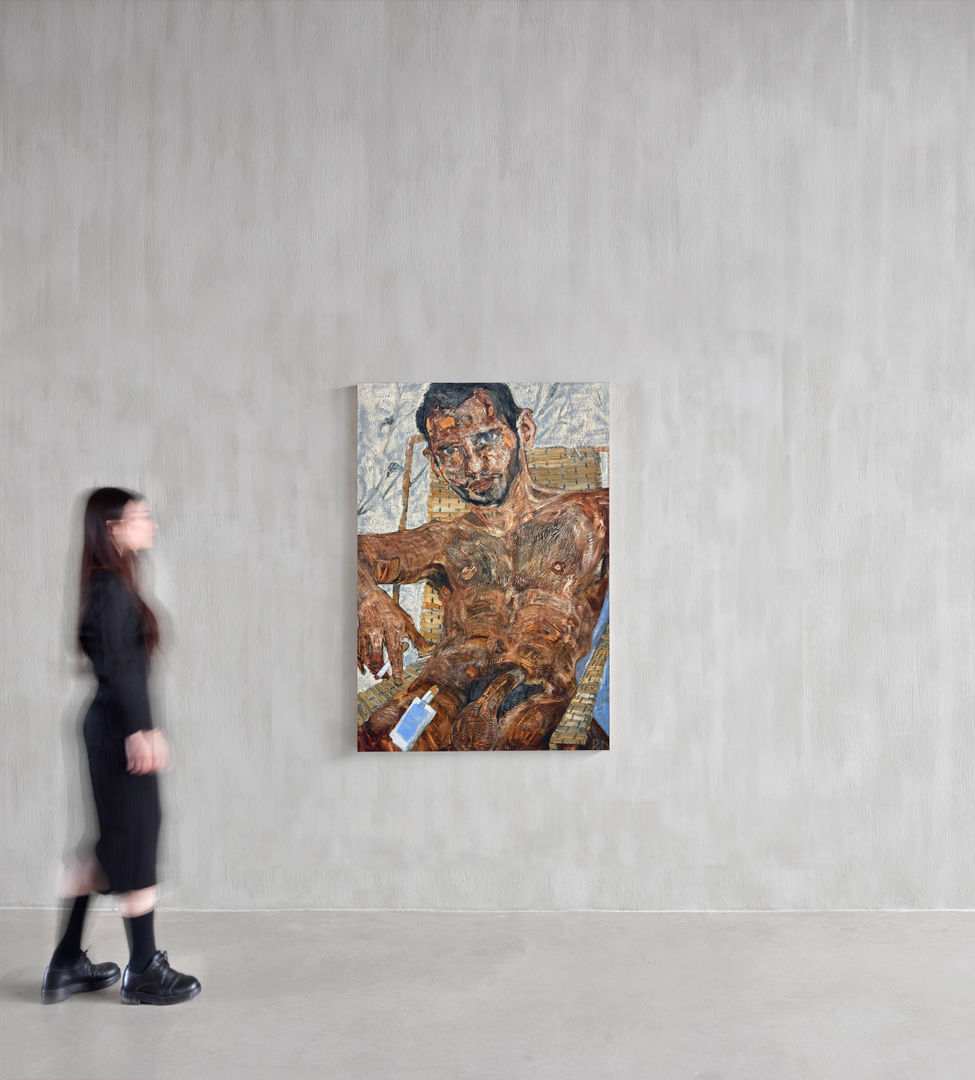
This language of contrast underpins the paintings in her Belgian debut solo exhibition, The Brighter The Light. Despujols works with thickly layered surfaces in earthy tones—burnt sienna, umber, rust—interrupted by moments of luminous color. Figures emerge from these grounds with a quiet intensity. Their gazes rarely avert themselves; instead they meet the viewer directly, as if asking to be read beyond the visible.
In Despujols’ work, the sitters are often those closest to her—her sister, her nieces, or fellow artists within her circle. In Astor Super Suave, the subject is the Colombian artist Sai Vargas. Here, the body occupies the canvas with a raw immediacy. Reclining in a woven chair, the figure appears both relaxed and exposed. The paint surface is restless—scraped, layered, and reworked—so that the body seems almost carved from pigment. Flesh tones shift between copper, ochre, and bruised violet, suggesting a figure shaped as much by memory as by light. A cigarette rests loosely in the hand, while a small blue cigarette pack lies near the thigh, its label reading “Astor Super Suave,” a discontinued Venezuelan brand. The detail introduces a quiet note of nostalgia, hinting at intimacy, habit, and the residue of place.
Across Despujols’ work, faces carry this same sense of interior complexity. They appear as repositories of experience—of fear, tenderness, endurance, and fleeting moments of joy. The paintings do not offer resolution. Instead they suggest that emotional life unfolds through layers of contradiction, where brightness and darkness remain inseparable.
Los Hijos del Cacao moves from solitude toward a fragile intimacy. Two figures cling to one another as they cross a flooded ground, their bodies entwined in a protective embrace. The younger figure holds tightly, while the older supports her with a quiet mixture of steadiness and concern, suggesting both care and shared vulnerability. Their large, searching eyes face outward, as if confronting the viewer—or an unseen presence beyond the frame. In the child’s hand, a small bag filled with bones introduces a darker note: a quiet relic of loss, memory, or survival carried forward. Around them, cacao pods and dense foliage form a canopy that feels at once nurturing and oppressive, enclosing the figures within a symbolic landscape where nature, memory, and inheritance converge. The title alludes to Venezuela’s long agricultural history rooted in cacao cultivation, before the discovery of oil dramatically reshaped the country’s economy and social fabric. Yet the flooded terrain and sense of precarious passage also evoke the contemporary reality of migration across Latin America—particularly the perilous crossing of the Darién Gap, the dense jungle between Colombia and Panama that has become one of the world’s most dangerous migration routes, where hundreds of thousands of migrants risk their lives traversing rivers, mountains, and lawless terrain in search of safety. In Despujols’ hands, these histories collapse into a single image: the figures appear suspended between inheritance and rupture, carrying both the remnants of the past and the uncertain weight of what lies ahead.
Across these works, Despujols constructs a world of layered emotional states. Joy carries the memory of suffering; intimacy contains the possibility of loss. The figures seem to hold these contradictions within their bodies, their expressions inviting the viewer to consider what cannot be fully articulated.
Motherhood has intensified this understanding for the artist.
“The arrival of my daughter brought a love so vast and luminous that it reshaped me entirely,” she writes. “Yet alongside that joy came fear, vulnerability, and uncertainty. The deeper the love, the greater the risk of loss.”
Within Despujols’ paintings, such oppositions are not reconciled but allowed to coexist. Light does not dispel shadow; it reveals its depth. What emerges is a world where the intensity of feeling—whether love, memory, or displacement—illuminates the fragile and complex terrain of being human.
